
Professional certifications are currently experiencing a crisis of confidence. If an AI program can successfully take a bar exam, a medical board test, or a CPA exam and achieve a passing grade, then it’s not just a matter of “how do we prevent applicants from gaming the system?” but “are we measuring the right outcomes in the first place?” AI isn’t merely shifting the goalposts on the testing process; it’s highlighting where the goalposts in defining competence were set up in the wrong place to begin with.
Table of Contents
Static Exams in a Shifting Skills Market
The traditional way is simple. You study, take a test, and then hold a credential for three years. The problem is, the skills market doesn’t follow a three-year cadence. The World Economic Forum’s Future of Jobs Report 2023 says that by 2024, 44% of worker competencies will change in the next five years. An official certification you earn today can be a lousy signal of your skills half that time into the future.
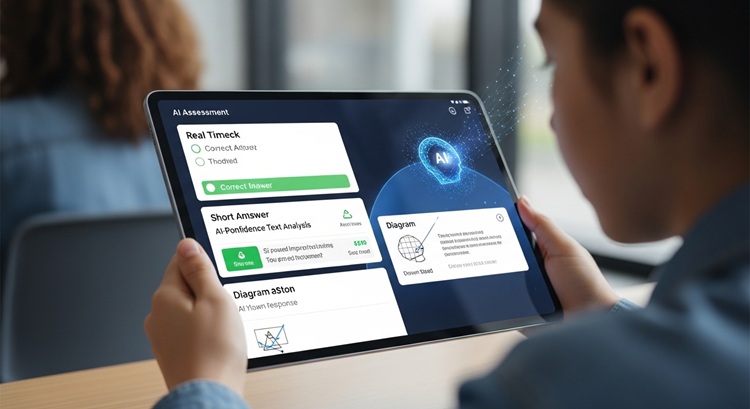
But AI can do something paper-based testing never could: Track your competency continuously. Rather than relying on a single snapshot in time, the entity issuing the certification could see what you know, and don’t know, in real-time. This gap could then be used to prompt additional learning, rather than waiting for the next renewal cycle.
Adaptive testing, where questions are served up based on the difficulty of those the candidate has answered correctly so far, has been theoretically possible for a few decades now. AI makes it practical. Item Response Theory, an approach that models the likelihood of a test-taker’s answer based on the question’s difficulty and the test-taker’s ability, makes it extremely effective as well.
The Brain Dump Problem is Solvable
Cheating in certification exams using “brain dumps” has been a long-standing issue in the industry. By automatizing item generation, this type of fraud can be significantly reduced since candidates will not have access to a fixed pool of questions to memorize. It’s not just a cool new technology, it actually makes exams more secure.
From Multiple Choice to Demonstrating the Skill
The more important change is the type of assessment. In the past, multiple-choice and short-answer questions were sufficient. If a job candidate didn’t know enough about the topic, they simply didn’t score well. The cheat risk was simply someone looking at a neighbor’s answer. But now, if a candidate can use a language model to write a convincing response, how do you ensure they actually know what they’re doing?
The response is a move toward performance-based assessment, tasks set in sandbox environments where candidates have to actually do the thing the certification claims they can do. A cybersecurity credential that tests a live incident response simulation is harder to game than one that asks which of four options describes the correct procedure. This aligns with Bloom’s Taxonomy in a useful way: the emphasis moves away from “remembering” and toward “creating” and “evaluating.”
The operational shift this requires is significant. Grading open-ended performance tasks manually doesn’t scale. This is where using AI in assessments becomes a practical necessity rather than just an efficiency play, Natural Language Processing allows for consistent, objective scoring of complex responses at a volume no human panel could match, while also generating specific, actionable feedback rather than a binary pass or fail.
Integrity Without Surveillance Overreach
Remote proctoring has made access to professional certification easier on a global scale. AI-led behavioral biometrics, like eye-tracking, typing cadence, and environmental noise can notice anomalies that a human administrator wouldn’t. It’s an integrity win.
At the same time, this data is incredibly personal and often recorded in the candidate’s home. Mitigating bias is a big concern here too. If the model is fed data that disproportionally reflects one group, candidates from the other group might have slightly deviant behavior flagged as suspicious. And certification bodies working under a framework like ISO/IEC 17024 need good, explicit, ethical guidelines on how to audit AI proctoring tools, and what to tell candidates about their data.
Here’s where the human-in-the-loop argument checks out. AI can process behavioral data at scale nicely. But humans need to set the rules for what the data means and what happens when the system flags it. That judgment isn’t something an algorithm should be allowed to make, flat out.
The Credential Has to Mean Something
Certification bodies that regard AI as a threat that must be dealt with will find themselves on the defensive for the next ten years. However, those that approach AI as a compelling rationale to redefine what their qualifications certify will seriously enhance the reliability of professional credentials and prevent their deterioration.
The objective is not to have AI conduct exams. The real goal is to have credentials that are trustworthy since they evaluate actual skills, on an ongoing basis, under the same conditions as real professional work. This is a more challenging criterion than one might expect. Nevertheless, this is the only criterion that is important to uphold.